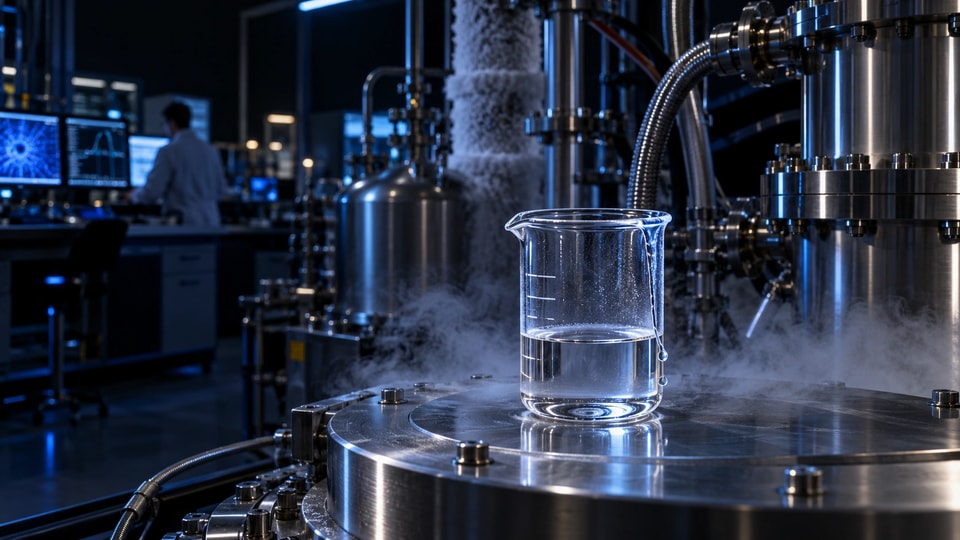
What would you expect if you poured a liquid into a glass?
For it to stay inside.
But what if I told you that some liquids can climb the wall of their container and flow down over the edge?
There is no pump. No pressure. No one is pushing the liquid upward.
The liquid is escaping its container on its own.
This is not science fiction.
It is called superfluidity.
And here is the remarkable part: It is not just the liquid behaving strangely. We are actually watching quantum mechanics operate at everyday scales right before our eyes.
What happens when you cool helium a little too much?
Normal helium is already a somewhat unusual element.
But if you cool helium-4 below approximately 2.17 kelvins, or -271 °C, things change dramatically.
The liquid enters a new phase called helium II.
In 1937, Pyotr Kapitza and John Allen and Donald Misener independently observed that this liquid flowed with extraordinary ease.
Kapitza compared this behavior to superconductors and gave it a fitting name:
Superfluid.
So what makes it so “super”?
First, think about honey
If you tilt a spoonful of honey, it flows slowly.
Water flows faster.
Motor oil might fall somewhere in between.
The reason is viscosity, the internal resistance a liquid exhibits against flowing.
In the superfluid component of superfluid helium, viscosity is zero.
In other words, as the liquid flows, it does not lose energy through the kind of friction we are familiar with.
If you create a flow in a ring, that current can continue for a very long time.
It is as if you pedaled a bicycle once and the wheel never slowed down.
But there is a small detail here.
Do not think of helium II as a single “frictionless liquid.”
Physicists treat it as a two-component system: a normal, viscous component and a viscosity-free superfluid component.
As the temperature falls, the proportion of the superfluid component increases.
So why do the atoms suddenly begin behaving this way?
Because the atoms are no longer playing alone
If you look at a glass of water at room temperature, you cannot see quantum physics.
But quantum mechanics is there too.
The problem is that the molecules move so quickly and chaotically that quantum effects become invisible at large scales.
When you lower the temperature almost to absolute zero, this noise decreases.
Helium-4 atoms also begin to display their quantum properties more clearly.
It becomes difficult to think of them as independent little marbles.
Large numbers of atoms begin moving in coordination within a shared quantum state.
Imagine a stadium.
If 50,000 people move independently, the result is chaos.
But if everyone makes the same movement at the same time, you no longer see individuals; you see the wave created by the entire stand.
Superfluidity is somewhat similar.
Of course, the atoms are not cheering in the stands, but the result is similar: microscopic quantum behavior becomes macroscopic.
What happens if it forms a vortex?
This is where things become even more interesting.
When you stir a cup of tea, you can create a vortex of any size you want.
That is not how things work in a superfluid.
Rotational motion is tied to specific quantum values, producing quantum vortices.
In other words, even the liquid’s vortex has to obey the rules of quantum mechanics.
That is why it is also incorrect to say that “a superfluid never loses energy under any circumstances.”
If you accelerate the flow sufficiently, vortices can form and energy loss can begin.
Nature has once again added a condition in the fine print.
The real trick: escaping its container
Now let us turn to the feature of superfluids most widely shared online.
You place superfluid helium in a container.
Then you wait.
The helium forms an extremely thin film on the inner surface of the container.
This is called a Rollin film.
The film climbs up along the wall.
It reaches the edge of the container.
It passes over to the other side.
And it flows downward along the outer surface.
After a while, the amount of helium inside the container may begin to decrease.
At first glance, the liquid appears to be defying gravity.
But is it really?
No.
Gravity is still doing its job.
Weak attractive forces between helium atoms and the surface create an extremely thin film. In a normal liquid, viscosity would largely prevent this film from moving.
In the superfluid component, that brake is absent.
The result?
The liquid moves along the surface and can escape over the edge of the container.
So helium is not defeating gravity.
It simply does not care much about the behavior we expect from liquids.
Why should we care?
Everything we have described so far may sound like an expensive laboratory demonstration.
It is not.
One of the world’s largest scientific machines actively uses superfluid helium.
Why does CERN keep tons of helium ice-cold?
The Large Hadron Collider’s giant superconducting magnets at CERN operate at approximately 1.9 kelvins.
At these temperatures, helium is in a superfluid state.
This provides an important advantage:
It can carry heat extremely effectively.
This property is critical for the stable operation of the powerful magnets located around the LHC’s 27-kilometer ring.
If too much heat develops at one point, superconductivity can be lost and the system may experience problems.
Superfluid helium serves as a kind of ultra-advanced cooling infrastructure.
CERN is also preparing more powerful systems for the High-Luminosity LHC.
So superfluidity is not merely a technology of the future; it is a technology of today.
It also appears in quantum computers
You cannot put a quantum computer’s processor on a desk and run it.
Superconducting qubits often operate at temperatures of a few millikelvins.
That is why large dilution refrigerators are used.
Mixtures of helium-3 and helium-4 play a critical role in these systems.
It would be too strong to say that “a quantum computer is powered by a superfluid.”
But operating many of today’s quantum computers would be quite difficult without ultra-low-temperature physics and helium technologies.
So are we limited to using superfluids only as coolants?
That is exactly what researchers are questioning.
Circuits that use atoms instead of electrons
In electronics, electrons flow through wires.
But what if we flowed atoms instead of electrons?
This is called atomtronics.
Researchers are creating superfluid rings from ultracold atoms and trying to produce persistent atomic currents in them.
In a sense, they are building electronic circuits from a quantum liquid.
At first glance, this may seem unnecessarily complicated.
But it has an important advantage.
These systems can be extremely sensitive to tiny rotations and accelerations in their surroundings.
Can we find our way without GPS?
Imagine a submarine.
It remains underwater for months.
There is no GPS signal.
Or imagine a spacecraft traveling millions of kilometers from Earth.
The vehicle must continuously measure its own rotation and the very small changes in its motion.
Superfluid-based quantum gyroscopes and atomtronic sensors could be used here in the future.
Today, many of these remain at the research or prototype stage.
But the goal is clear:
To measure smaller movements.
To drift less.
To determine position accurately for longer periods without receiving an external signal.
In short, we will not be carrying a superfluid reservoir in our phones one day.
But submarines, spacecraft and precision navigation systems may benefit from this physics.
Can you study a neutron star with a liquid?
There is an even stranger application.
We use superfluids to imitate other physical systems.
For example, part of the matter inside neutron stars is thought to be in a superfluid state.
But since you cannot bring a neutron star into the laboratory, another approach is needed.
This is where ultracold atoms and superfluid helium become small-scale simulation systems.
Researchers study quantum vortices.
They investigate turbulence.
They seek to understand how dense quantum matter behaves.
Some studies even aim to use superfluid systems to experimentally simulate difficult problems in quantum field theory.
In other words, a few centimeters of cold liquid on a tabletop can sometimes help us understand the physics inside a star thousands of light-years away.
So what will we ultimately get?
The future of superfluids probably will not be a “frictionless car engine.”
At least not in the near future.
But they could be much more meaningful in other areas.
More powerful particle accelerators.
More precise quantum sensors.
Navigation without GPS.
Next-generation gyroscopes for spacecraft.
Advanced cryogenic systems for quantum computers.
And quantum simulators that reproduce physics we could not otherwise experiment with in the laboratory.
This may be the most beautiful thing about superfluids.
We usually think of quantum mechanics as something belonging to the small world of atoms and particles.
But if you cool helium sufficiently, quantum physics leaves the microscope and appears directly before your eyes.
Sometimes, it even climbs over the edge of the container.